
You live with lithium ion every day. In your phone, your laptop, your power tools, your ebike. When those batteries behave, life is smooth. When they do not, things go sideways fast. Fire departments across the country keep sounding the alarm, because lithium battery fires spread fast and produce thick smoke. This guide lays out safe charging, smart storage, warning signs of damage, what to do in a heat or smoke event, how to buy safer ebikes and scooters, and how to dispose of packs the right way. Straight talk from a restoration pro who has seen the mess after the sirens.
Why home battery safety matters
Lithium cells pack serious energy in a small space. That is the point. It also means a small failure can escalate. Heat, physical damage, or a mismatched charger can push cells into thermal runaway. Once that chain starts, flames spread to nearby combustibles in seconds. The United States Fire Administration highlights simple home steps that cut risk, like charging in sight and keeping devices at room temperature. Their core message is simple. Choose certified products. Recycle properly. Get out fast if a fire starts. You can read that household guidance at USFA.
Quick safety checklist
Keep this short list in view near your charging spot. It covers the most common mistakes I see after a callout.
- Use the charger that came with your device or the same model from the maker. Skip universal chargers. A federal safety official has linked those to fires. See the warning from CPSC.
- Charge on a hard surface in sight. Keep away from exits and bedrooms. Never charge while you sleep. The FDNY keeps repeating this for a reason.
- Keep devices and spares at room temperature. No hot cars. No direct sun. Keep clear space around them. The USFA lists temperature tips for households.
- For long storage, park lithium ion around half charge. About thirty to fifty percent. That reduces stress on the cells. See Battery University.
- Stop use if you see swelling, smell a sweet or solvent odor, feel heat when idle, hear hissing, or see discoloration. Princeton EHS maintains a clear hazard list at EHS Princeton.
- If a device overheats or smokes, unplug if safe, move away from things that burn, get people out if needed, call 911. More tips from FDNY Smart.
- Do not put lithium batteries in trash or curbside recycling. Tape terminals or bag each pack. Take to a drop off site. The EPA explains how.
Charge safely at home
Charging is where most incidents start. The fix is simple. Match the charger to the device. That means the original charger that came with your ebike, scooter, tool, or gadget. Or the same model from the manufacturer. Many fires trace back to mismatched charge voltage or a cheap charger that lacks proper protection.
Federal safety officials have warned consumers not to use so called universal chargers for ebikes. These chargers can overcharge or stress the pack. That can trigger failure during charging or later when the pack sits. Read the statement from Commissioner Trumka at the CPSC for a clear warning in plain words.
Set your charging station on a hard, level, nonflammable surface. Think tile, concrete, a metal shelf, or a stone countertop. Give the device space for air flow. Keep the charger off plush rugs, couches, or beds. You do not want heat trapped in soft material.
Keep the area free of boxes, curtains, and solvent containers. No cardboard pile next to your charging ebike. No stacks of paper under a scooter. Do not charge near an exit path. You need a clear route out if something goes wrong.
Watch charging in real time. If you must leave, unplug and finish later. Never charge while you sleep. Sleep gives a fire time to grow unchecked. That is not a risk you need to take for a full battery in the morning.
Do not use a damaged charger or cable. If the cord is frayed or the plug feels hot to the touch, retire it. If the charger hums, clicks, or smells like hot electronics, retire it. These are early warning signs of failure.
Store batteries the smart way
Storage is not glamorous, but it matters. Heat is the enemy. So is cold that swings to heat. Keep devices and spare packs at normal room temperature. Choose a dry space with no direct sun. A hallway closet that stays cool works well. A garage can work if temperatures stay moderate. A hot car can cook cells in a single afternoon. Skip that decision.
Keep devices away from fuel, paint, or bulk combustibles. A tidy corner beats a crowded shelf. Avoid stacking heavy items on top of a battery pack or over a laptop with a sealed pack. Pressure can deform the case. Deformation means risk.
For storage that lasts more than a month, set the charge to roughly half. About thirty to fifty percent. That state of charge reduces stress on the chemistry. It also gives the pack room in case of slight self discharge. Over many months, top off to that midpoint again. See the storage science breakdown at Battery University.
Remove batteries from devices you will not use for a while if the design allows it. Store each pack in a nonmetal container or a soft pouch. Keep terminals covered so they cannot short if items shift.
Apartment living adds a twist. Keep ebikes and scooters away from doors and stairs. If your building allows outdoor charging or storage in a locked area, use that. State fire officials advise keeping micromobility devices clear of exits. See a concise guide from Massachusetts.
Do and do not for home charging
| Do | Do not |
|---|---|
| Use the OEM charger or an approved replacement | Use a universal or unknown brand charger |
| Charge on a hard, nonflammable surface in sight | Charge on couches, beds, or rugs |
| Keep devices away from exits | Block doorways with charging gear |
| Unplug when the charge cycle completes | Leave devices on charge all night |
| Replace cords that show heat or damage | Wrap frayed cords with tape and keep using them |
Signs of battery damage
Early warning signs are your best friend. If you see any of the signals below, stop using the device. Move it to a nonflammable surface in a clear area. Disconnect power. Monitor it for heat. Then contact the maker or a qualified service shop for guidance.
Watch for these signs of lithium battery damage. I see them often during inspections after a fire.
- Swelling or bulging packs. A phone that no longer sits flat. A laptop trackpad that lifts.
- Unusual sweet or solvent odor. A chemical smell that was not there before.
- Heat when idle. The device warms up while sitting. No charging. No heavy use.
- Discoloration or melted plastic near the battery bay. Scorch marks near vent holes.
- Hissing or popping sounds. Tiny puffs of vapor. Any smoke at all.
- Leaking fluid. Staining around seams or ports.
Do not poke a swollen pack with a pin. Do not clamp it to make it flat. Treat it with respect. Safety pros at Princeton EHS maintain a detailed hazard list that matches what fire crews see. Review that list at EHS Princeton.
One more point that matters. Do not buy unknown aftermarket ebike batteries or so called upgrade packs. The federal agency that handles recalls issued a stop use warning for a popular aftermarket ebike battery brand in 2024. That warning cites fire and burn hazards. You can read the notice and check for updates at CPSC. If you already bought one, search your model on SaferProducts dot gov before another ride.
If a battery overheats or smokes
Stay calm. Fast, simple steps make the difference. Your goal is to break the heat chain and protect people first.
Use this one screen action list when a device feels too hot, smells wrong, or smokes.
- Stop charging. Unplug from the wall if you can do it safely.
- Move the device away from anything that can burn. A tile floor or concrete patio works well. If the pack is deforming or smoking, wear gloves and use a long tool to slide it if you must move it. If movement is risky, skip it.
- Get people and pets out if smoke builds. Close doors behind you to slow spread.
- Call 911. Tell the dispatcher that you have a lithium battery incident.
- Do not pick up a smoking device with bare hands. Do not cover it with a blanket. That traps heat.
Firefighters often use large amounts of water to cool big lithium ion fires. Cooling slows or stops thermal runaway and can prevent spread to other cells. That is the playbook in aviation and other fields. At home, your first move is evacuation and a call to 911. Read the cooling principle in the FAA guide at FAA PackSafe.
The FDNY advises that if you see odor, swelling, or leaking, stop using the device and call 911. That advice matches what we see during fire restoration. Early action prevents a small heat event from becoming a full fire.
Ebike and scooter certification
Not all micromobility gear is built the same. Certification matters. Look for the UL mark on the system label, battery label, or charger label. UL 2849 covers the electrical system on an ebike including the battery, drivetrain, and charger. UL 2271 covers batteries for light electric vehicles. UL 2272 covers personal mobility devices like hoverboards and some scooters. You can read a clear consumer guide to the mark and learn how to verify products in the UL Product iQ database at UL Solutions.
To be clear, a label that says tested to a standard is not the same as certified to that standard. A proper UL mark comes with a control number and traceable listing. You can verify that in Product iQ before you buy. If a seller cannot show a mark on the product or listing, walk away.
UL 2849 defines safety requirements for the entire ebike electrical system. It looks at faults across components, not just the battery in isolation. See that scope and a note on New York City law at UL Solutions. New York City already requires certification for ebikes and scooters sold in the city. National rules are moving. The federal product safety agency advanced a testing proposal in 2025 that points toward broader alignment with UL 2849, 2271, and 2272. See the update at Bicycle Retailer.
Safety labs have noted that UL 2849 has recognition within ANSI. That matters for code officials and insurers. A short summary is posted by SGS. If you want the short version from a restorer. Buy certified. Keep the receipts. Take photos of the labels. You will thank yourself if you ever need to file a claim.
Charging rules for ebikes and scooters match what you do for phones and tools. Match the charger. Charge in sight. Keep away from exits. Never mix or match battery brands and chargers. The CPSC issued a stop use warning on a popular aftermarket ebike battery line in 2024. That warning exists because mismatched parts fail. See that notice at CPSC.
Dispose and recycle the right way
Household bins are not for lithium ion. Curbside recycling is not for lithium ion. Wrong disposal can spark a truck fire. Local crews hate that call. Do this instead.
Prep each battery for drop off. Tape over exposed terminals with clear packing tape or duct tape. Or place each battery in its own clear bag. Store the prepped batteries in a nonmetal container until you can drop them off. If a battery is damaged or swollen, contact your city household hazardous waste program for guidance before you head to a retail drop box. The EPA lists prep steps in simple language.
Need a drop site. Use Earth911 or Call2Recycle to locate a nearby collection point. The EPA links to both. Many big box stores can accept small device batteries, though staff may have limits for large packs. Call first for ebike packs or tool packs with high capacity.
In New York City it is illegal to throw rechargeable batteries in the trash. Many states have similar rules. The FDNY maintains a clear page that covers storage rules and recycling links. You can view it at FDNY Lithium Ion Safety. Texas residents can search for household hazardous waste events and permanent drop sites by county. If you are in our service areas in Central Texas, contact your city solid waste department for HHW schedules.
When damage happens call pros
Even a small battery flare up can fill a home with smoke. Smoke coats HVAC internals, drifts into wall cavities, and settles in clothes and soft goods. Soot is acidic and keeps working on metals and finishes after the flames are out. Fast cleanup changes outcomes.
My team handles the fire scene from board up to build back. We start with safety, stabilization, and source removal. We capture and bag debris. We triage contents for cleaning or discard. We set up negative pressure, HEPA air filtration, and deodorization. Then we test surfaces and ductwork for soot. If you need help right now, tap our page on Fire and smoke damage restoration with 24 hour emergency response.
Smoke has a nasty habit of settling in vents and electronics. Learn how it moves through HVAC and contents in our post on how smoke seeps into HVAC and contents. If you are staring at a scorched charger and a blackened wall, start with scene photos, keep receipts, and call your carrier. We outlined the first steps after a home fire in this guide to first steps after a home fire.
Claims can feel like a second job. Claim handlers need clear documentation. We wrote a walkthrough on how to document and file a fire damage insurance claim. You can also read general insurance tips after fire, smoke, or water damage so you stay ahead of paperwork.
Quick note for a heating or smoke event that triggered sprinklers or a hose line. Water soaks framing and flooring. Drying starts in the first twenty four hours to prevent secondary damage. We set moisture maps, remove wet materials as needed, and stabilize the indoor climate to stop mold growth.
Where to place your charging spot
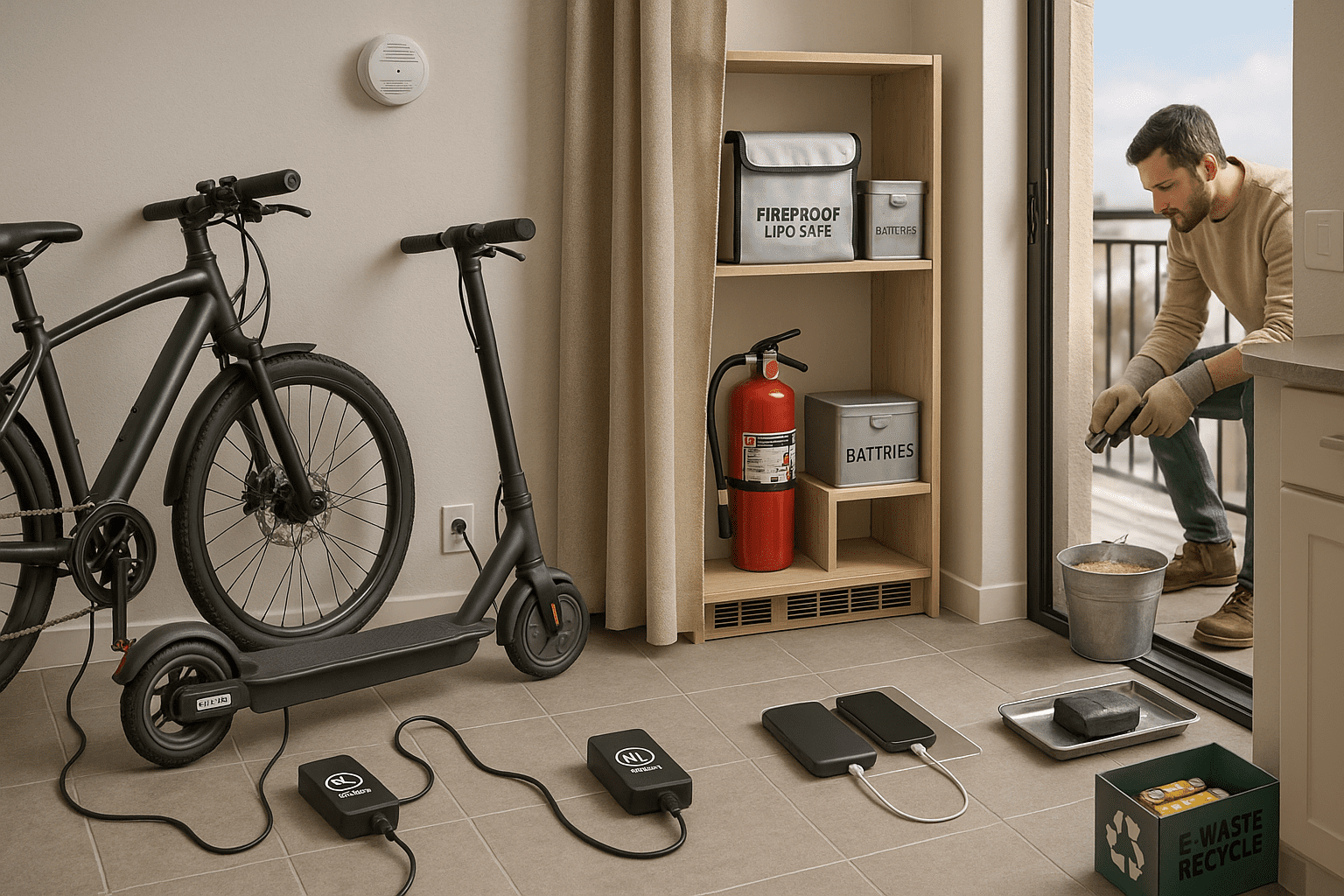
Pick a spot you can see while you live your normal life. Kitchen counter with stone. Laundry room with tile. Garage workbench with a metal top. Keep three feet of clear space around the device. Place a smoke alarm nearby. Keep a household fire extinguisher where you can grab it on the way out. Do not block your only exit from a room. Do not charge in hallways or on stairs.
In apartments or condos keep ebikes or scooters near an exterior wall if you can. A patio or balcony that stays dry can be a better choice for storage. Local rules vary, so check your building policy. The Massachusetts guidance suggests keeping devices away from exits and outside if possible. That advice translates well to any state.
How to verify UL certification
Counterfeit marks exist. So the label check is step one, not the finish line. Do this quick verification before you buy.
Look for a UL mark on the product, charger, or battery. Snap a photo of the label. Go to UL Product iQ. Search the brand and model. Confirm the listing matches your product. Confirm the standard named on the listing matches your use. UL 2849 for ebike systems. UL 2271 for removable light vehicle batteries. UL 2272 for personal mobility devices. The consumer guide from UL Solutions walks through this with label images.
If you cannot find a listing, ask the seller for the UL file number. If they dodge, pick a different product. If the seller claims tested to a standard without a listing, pick a different product. Cheap now can cost a rebuild later. My crews have seen it too many times.
What a safe charging cycle looks like
Let us keep this simple. Plug the OEM charger into a wall outlet. Avoid power strips loaded with other devices. Place the device on a hard surface with space. Watch for the normal charge indicator. Set a timer that matches your typical charge time. Unplug when the indicator shows full. Let the pack rest before heavy use to reduce heat stacking if you just finished a long ride or a long job.
If your pack has a user manual with recommended state of charge bands for daily use, follow it. Some devices allow partial charging to eighty percent for daily use to reduce stress. That can extend battery life. A little patience pays off.
Kids, guests, and shared spaces
Kids love scooters. Teens love ebikes. Friends bring portable power banks to movie night. Set house rules. A no charging during sleep rule. A no charging on beds or couches rule. A no guest chargers on unknown devices rule. Keep borrowing to certified gear. Teach kids the signs of battery trouble. If they smell something strange while gaming on a laptop, they should pause and speak up.
The truth about fire extinguishers and lithium ion
People ask if they can put water on a lithium ion fire. In a home setting your priority is life safety. Evacuate. Call 911. Firefighters often use water to cool cells and stop propagation. That takes a lot of water and training. For a small device that only smokes with no sustained flames, moving it to a clear, nonflammable area can help reduce risk while you wait outside for help. The FAA principles speak to cooling during air incidents. Review that guide at FAA PackSafe. Do not take risks inside a structure. Smoke is toxic and robs time.
Apartment and condo rules you should know
Some cities spell out micromobility rules for residents. New York City does. It bans disposal of rechargeable batteries in trash. It sets expectations for storage and charging. It shares multilingual handouts with basic rules. If your city has guidance, follow it. You can view an example at the FDNY Lithium Ion Safety page. Property managers often mirror these points. If you rent, ask for the policy and post it near your charging spot.
Repair or replace after damage
A battery that shows swelling or heat at rest is not a project for your weekend. Contact the manufacturer. Ask about warranty or takeback. Many will accept damaged packs for proper handling. Do not mail a damaged pack without the maker’s instructions. Shipping rules for hazardous materials apply. If your device is under recall, stop use. Replace or refund.
Do not try to rewrap a torn pouch cell with tape. Do not try to drill a packed battery shell to release gas. I have seen those fails. You do not want that smoke in your lungs or that flame in your living room.
If you need to set up a safe charging corner
Create a simple station that you can replicate. A metal wire shelf with a ceramic tile on each shelf. A power outlet with no other heavy loads on the circuit. A smoke alarm overhead. A clear plastic bin nearby for safe storage of spare packs with terminals taped. A small metal bucket with a lid to place a heating phone or tool while you head outside. Keep the exit path clear. Keep a flashlight in the drawer for nighttime issues.
FAQ
What are the signs of a damaged lithium battery
Watch for swelling, a sweet or solvent odor, heat when idle, discoloration or melted plastic, hissing or popping, smoke, or leaks. Stop use if you see any of these. Princeton EHS maintains a solid checklist at EHS Princeton.
Where should I charge an ebike battery in an apartment
Pick a hard surface in sight with space around it. Keep away from exits and bedrooms. Never charge overnight. Fire departments like the FDNY post clear apartment tips at FDNY Smart.
Is a universal ebike charger safe
No. Use only the charger that came with your bike or an approved replacement from the maker. A CPSC commissioner warned that universal chargers have caused fires. The statement is posted at CPSC.
Can I use water on a lithium ion battery fire
At home your priority is life safety. Evacuate and call 911. Firefighters use large amounts of water to cool cells and prevent spread. That takes training and volume. The cooling principle is described at FAA PackSafe.
How should I store lithium batteries I am not using
Keep them at room temperature in a dry spot with no direct sun. Store around half charge for long periods, about thirty to fifty percent. A nonmetal container is a smart choice. See storage tips at Battery University.
How do I dispose of a swollen laptop battery
Handle it carefully. Tape terminals or bag it. Place it in a nonmetal container. Do not put it in household trash or curbside recycling. Contact the maker or your city HHW program for drop off guidance. See disposal tips from the EPA.
How do I know if an ebike is UL certified
Look for a UL mark on the bike, battery, or charger. Then verify the listing in UL Product iQ. Confirm the model and standard. The consumer guide at UL Solutions shows what to look for.
Final word from a restorer
You do not need fear to live with lithium ion. You need simple habits that cut risk. Use the right charger. Charge in sight. Store cool and clear. Know the signs of a problem. Buy certified gear. Recycle the right way. If a fire happens, get everyone out, call 911, then call a team that knows how to clean soot without spreading it deeper into your home. If you smelled smoke or noticed swelling in a battery and a fire occurred, our 24 hour team can help with cleanup and repairs. Start with a free estimate at our page on Fire and smoke damage restoration with 24 hour emergency response.