
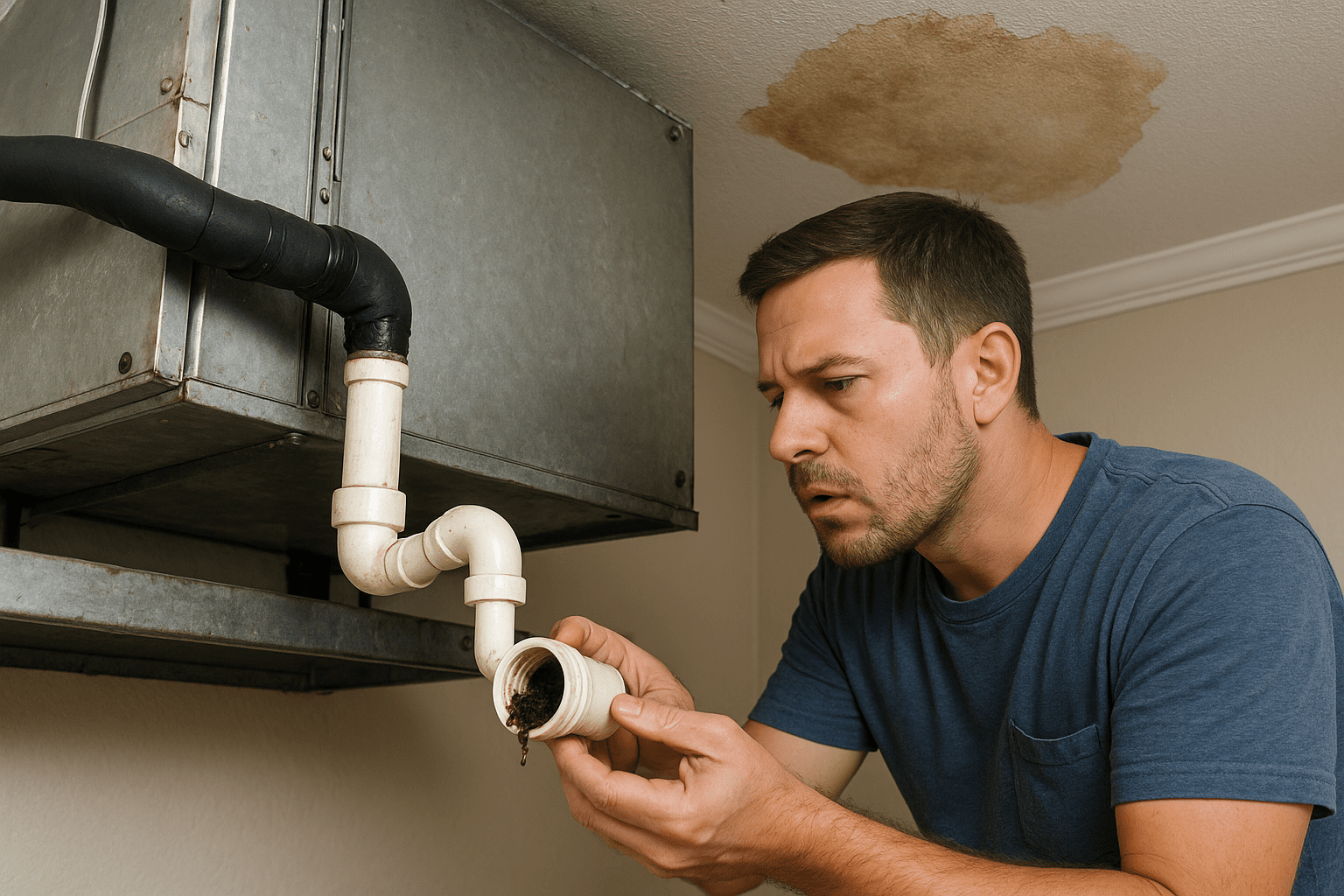
Your air conditioner should cool the house, not paint abstract art on the ceiling. A clogged condensate drain sends water where it does not belong. That turns into stains, musty odors, dripping drywall, and a fast track to mold. I own a restoration company. I have seen a tiny drain line bring down entire living rooms. The good news is prevention is simple. This guide shows clear signs of a clog, a quick monthly routine that works, smart safety add ons like float switches and auxiliary pans, plus when to hand it off to a pro. If you already see suspicious spots, check our guide to hidden water damage signs then keep reading.
Why overflows matter
Your air conditioner pulls humidity from indoor air while it runs. Moisture condenses on the evaporator coil. That water drops into a drain pan and flows out through a small PVC line to the exterior or a plumbing tie in. When that pathway gums up with algae or debris, condensate cannot leave. It backs up. The pan fills. Then it overflows onto ceilings, walls, and insulation.
Water in the wrong place acts fast. Ceiling paint bubbles then peels. Drywall swells then sags. Insulation clumps and loses performance. A slow drip turns structural if it runs long enough. Wet materials become a buffet for mold. The EPA points out that mold grows on damp organic surfaces quickly, often within a day or two. HVAC areas stay dark and humid, which gives spores a head start. Once mold colonizes a ceiling cavity, cutting it out and drying the structure is not a weekend project.
I have also seen water reach fan compartments and electrical boards. That can short components and shut your system down when you need it most. A small overflow can turn into a heat wave with no cooling. If this already happened, stop reading and call for emergency water cleanup so you do not stack more damage on top of the first hit.
The point is simple. HVAC condensate overflow protection is not fancy tech. It is a small set of habits and safeguards that block a very boring, very expensive type of loss. Keep water in the pan for only as long as it takes to move through the line. Keep it moving. Keep your house dry.
Clog signs you can spot
Most homeowners catch a condensate issue if they know what to watch. You can spot trouble long before water finds the nearest sheet of drywall.
Start with the obvious. Look around the indoor unit. If the air handler sits in an attic, peek at the area around the access hatch. If it sits in a closet, open the door and check the floor or the platform. Any moisture is a red flag. Fresh drips, rust streaks, a damp smell, tiny trails of sand or dirt near the drain port, all point to a line that is not carrying water out.
Step outside and find the condensate pipe discharge. This is usually near the outdoor unit or near a wall where the indoor unit sits. On a hot, humid day while the system runs, you should see a steady drip. No drip during active cooling often means a clog. A trickle that stops and starts can also be a sign of slime buildup. AHS shows simple checks and a safe cleaning process in its homeowner guide, which you can read here.
Use your nose. A musty odor from vents tells you moisture is hanging around. That can be a drain issue or a filter problem, but either way it needs attention. The odor comes from microbial growth that loves damp surfaces. Dry systems do not smell like a basement after a rainstorm.
Watch for system behavior that does not match the thermostat. If the AC shuts off even though the thermostat still calls for cooling, a float switch may have tripped. That is a good thing, since it prevents overflow. It also tells you water collected where it should not stay. Resetting the equipment without clearing the cause is like turning up the radio to ignore a check engine light.
Check walls and ceilings below the air handler. Spots that look like tea stains around recessed lights or along seams often trace back to condensate. Our post on hidden water damage signs shows more visual cues. If you see any, take them seriously. Water marks rarely vanish on their own. They grow.
In cooling mode, ice on the evaporator coil or the refrigerant line can also hint at poor airflow or a drain problem. Ice melts when the system cycles off. Meltwater then spills into the pan all at once. A clean drain is the only way that extra volume can leave without trouble.
Bottom line. See water where it does not belong, smell musty air, hear the system short cycle, or see no drip outside during active cooling. That is your sign to act now.
Monthly maintenance that works
You can prevent AC drain line clog issues with one small habit. Give the condensate line a little attention once a month during the cooling season. This takes less time than making coffee. It can save you thousands.
Start by cutting power to the system. Turn the thermostat to Off. Flip the breaker for the air handler to Off. That keeps you safe while you open access caps or move wiring near the pan. AHS makes the same point in its homeowner steps, linked above.
Find the access point. Most installations include a short vertical cap at a tee near the air handler. It looks like a little white chimney on a PVC line. Remove the cap. Shine a flashlight down into the tee. If you see clear water flowing slowly, that is fine. If you see stagnant water or sludge, plan to clean.
Check the primary drain pan under the evaporator coil. If you can see it, look for rust flakes, biofilm, or floating debris. Any standing water tells you the drain path is slow. Mop or vacuum out pooled water. A small wet dry vacuum is perfect for this. If access is tight, you can often vacuum at the outdoor end of the pipe to pull the clog toward you. Homeowner guides at AHS and Homes and Gardens show this method in simple steps.
Flush with distilled white vinegar. Pour a quarter cup to one cup into the tee using a small funnel. Let it sit fifteen to thirty minutes. Vinegar cuts slime without beating up the PVC. Many homeowner sources suggest vinegar as a routine treatment because bleach can corrode metals and harm finishes. You can review that guidance in the AHS cleaning article. After the soak, pour warm water into the tee to push the loosened film out. Do not overfill the pan while the system is off. Slow and steady wins.
Look at the outdoor discharge while you flush. You should see clouded water and small bits of slime wash out. The stream should turn clear by the end. If not, use the vacuum at the outdoor port again. A gentle seal with your hand often works better than a hard clamp. Add a rag to improve suction if needed.
Consider preventive tablets designed for AC pans. These release a small amount of algaecide and help keep growth from spiking during humid spells. Home centers sell products for this purpose, like the Web AC line cleaner you can find at stores such as Home Depot. Use products labeled for HVAC pans. Follow directions on the label.
Replace the air filter on time. A dirty filter allows more dust to reach the coil and pan. Dust feeds biofilm. Fresh filters reduce sludge. Angi and AHS recommend timely filter swaps as part of drain maintenance. I back that advice on every service call I make.
Finish by restoring power and running the system for a few minutes. Walk outside and confirm a steady drip. Add a calendar reminder to repeat the quick routine every month during peak cooling. In high humidity climates, monthly is smart. In milder climates, every one to three months works for many homes. The AHS guide suggests the same cadence.
One extra note for homes with attic air handlers. Keep a flashlight near the attic hatch. Add a monthly attic walk to your routine during summer. Ten seconds of looking can stop a soaked ceiling before it starts.
Homeowner tools that help
You do not need a truck full of equipment to keep a drain clear. A few simple items cover nearly every task.
A small wet dry vacuum handles most clogs. Use it at the outdoor drain termination. A short section of flexible tubing and a rag help create a seal. A funnel and a measuring cup make vinegar treatment tidy. Keep a jug of distilled white vinegar on your shelf. It stores well. It works. It costs next to nothing.
Pan treatment tablets designed for HVAC use fill the gap between flushes. Stores carry many options, like the Web AC line cleaner tablets linked above. Choose a product that lists condensate pans on the label. Place it where water passes during normal operation, not in a dry corner of the pan.
Basic PVC fittings like a new tee cap or a cleanout plug are cheap. If your access cap is missing or cracked, replacing it helps keep dust out. Do not glue a cap shut. You want easy access for future service.
A decent flashlight is your best friend. Condensate issues hide in dark corners. Light makes problems obvious. Your future self will thank you.
Safety add ons that stop leaks
Prevent AC drain line clog tricks keep water moving. Safety add ons catch problems when the line still fails. Professional installers use a few parts to stop overflow before it hurts the house. Some are required by code when a unit sits where a leak could damage building materials. The common pieces include auxiliary pans, secondary drains, float switches, and condensate pumps.
Start with the auxiliary pan. If your air handler lives in an attic or above a finished space, it should sit over a large sheet metal or plastic pan that extends past the unit on all sides. That pan is the backup catcher. It catches overflows if the primary pan fails or the primary drain plugs. The pan should have its own drain line that terminates in a conspicuous spot outside. Conspicuous means you can see water dripping and know something is wrong. The International Code Council points to this practice for installs over finished areas. You can read a plain language summary on the ICC site here.
Secondary drain lines provide another layer. Some coil drain pans include a second port higher than the primary outlet. When the primary port clogs, water rises to the second port and exits through a separate line. That line should also discharge where people will notice the drip. If you see that pipe run water on a clear day, call for service. It is a warning siren in pipe form.
Float switches are the real hero. A float switch senses a rising water level. When water lifts the float, the switch opens the low voltage control circuit. That shuts the system off or sends an alarm. The unit stops making water. The pan stops rising. The flood stops before it starts. Manufacturers like Little Giant show several mounting options and explain correct wiring on their product pages. See an example here.
Where should a float switch sit. You have a few choices. Many techs place an inline switch on the primary drain line near the coil. Others place a switch in the auxiliary pan. Some use a clip on switch that senses water at the secondary drain port. Each style has pros and downsides. A switch in the primary pan or line reacts early, which is great. A switch in the auxiliary pan protects the house if the primary pan cracks or a fitting fails. HVAC School covers trade debates on placement and wiring in this article. The shared theme is simple. Install a switch. Wire it to shut the system down. Level it right to avoid false trips. Test it during service.
Condensate pumps deserve a spot in this section too. Not every system can drain by gravity. Basement units often pump water up to a higher drain. Attic units sometimes need a lift to a distant discharge. A good pump collects water in a small reservoir. When the level reaches a set point, the pump runs and sends water out. If the pump fails, many codes call for an interlock that stops the equipment so it does not fill the reservoir and overflow. The ICC summary linked above touches on pump interlocks and auxiliary protection concepts. If your pump has no safety shutoff, ask your HVAC company about adding one.
None of these parts prevents clogs by itself. They prevent damage when a clog wins. Think of them as seat belts for your system. Please click the belt.
Code basics you should know
HVAC installs fall under mechanical and residential codes that vary by jurisdiction. There is one theme across the board. If a unit sits where an overflow can damage the building, you need auxiliary protection. That protection can be a separate drain pan with a dedicated line that drips in a place you can see. It can be a pan with a float switch that shuts the unit down. It can be a secondary drain port piped to a spot where you notice the drip. Some setups use a combination.
The International Mechanical Code and related standards call for corrosion resistant pans that extend under the full unit. They require the discharge of the auxiliary drain to be conspicuous. They require pump interlocks in certain configurations so a failed pump does not let the unit continue to make water. You can read a code oriented summary on the ICC Building Safety Journal. Local inspectors may have specific preferences for line size, trap placement, or discharge locations. Your installer should know your area. Ask them to show you how your protection works while you can still reach it easily.
If a contractor installs an attic system without an auxiliary pan and safety switch, that is a problem in many areas. If your home came that way, correct it before summer. A pan and switch cost far less than a living room ceiling replacement. If water has already caused staining, our team can handle drying and repairs through our water damage restoration services.
Call a pro when these happen
I like DIY pride as much as anyone. I also like intact ceilings. Hand this off when the situation calls for pro tools and training.
Call an HVAC tech if you clear a line, it clogs again within weeks, or a float switch keeps tripping. That suggests a deeper restriction, poor drain pitch, or microbial growth that needs stronger treatment. Call if you find ice on the evaporator coil. Ice points to airflow or refrigerant issues, which are not DIY items. Call if the drain line disappears behind finished walls or a slab, since access may require new cleanouts.
Call a restoration pro if water already reached drywall or insulation. If you notice sagging, blistered paint, or a strong musty odor, you may already have a hidden cavity that needs drying. Our post on hidden water damage signs covers what to look for. Swift action limits mold. If you want a road map to dry the space safely, read our guide on how to dry out and mold prevention. If mold has already shown up, we handle mold remediation with containment and HEPA filtration.
Expect typical costs for simple drain cleaning to sit around seventy five to two hundred fifty dollars depending on the market and access. Sources like AC Genie publish similar ranges in their cost guide. Pan repairs or replacement parts can add one hundred fifty to six hundred dollars. Water damage repair varies with size and materials. A small ceiling patch with paint is one thing. A soaked attic with blown in insulation is another. If you need urgent help, use our 24/7 emergency response to get a tech on site.
One final sign to call for help. If you see any growth, do not spray random chemicals around your air handler. That risks pushing spores through the ductwork. Shut the system down. Call for mold testing or remediation guidance.
Quick FAQ
How often should I flush the condensate line
For most homes, every one to three months works during the cooling season. In hot, humid climates, monthly is smart. AHS makes the same suggestion in its homeowner guide linked above.
Should I use vinegar or bleach
Use distilled white vinegar for routine maintenance. It cuts slime without being harsh on metals and finishes. Keep bleach for severe situations and only if your equipment maker allows it. The AHS guide supports vinegar for regular care.
Do I need a float switch
If your system sits in an attic or over finished space, yes. Many codes require auxiliary protection in spots where overflow can damage the building. A float switch that shuts the system down is a smart layer of HVAC condensate overflow protection. The ICC summary covers auxiliary protection expectations.
My AC shuts off randomly. Could that be a float switch
Yes. A tripped float switch cuts the low voltage control circuit and stops cooling so you do not get an overflow. Clear the drain, empty any water in the pan, then reset power. If it trips again, call a tech.
What if my home has a condensate pump
Test the pump every season by lifting the reservoir float gently. The pump should run and drain. A safety interlock should shut the system down if the pump fails. If your pump lacks a safety interlock, ask an HVAC pro to add one. The ICC guidance touches on that requirement.
Can I prevent AC drain line clog issues with tablets alone
Tablets help, but they do not replace vinegar flushes and a visual check. They slow growth. They do not remove existing sludge. Use them as a helper, not a cure all.
What if I already see mold near my air handler
Do not run the system until a pro checks it. Growth near an air handler can spread through ducts. We provide mold remediation with containments, air scrubbers, and safe removal methods.
Need help right now
If you see active dripping, ceiling stains, or a musty smell that will not quit, do not wait. We are on call around the clock for water damage restoration services. If you want a fast site visit for water mapping and moisture checks, reach out through our contact Blackhill Restoration page.
Keep your condensate line clean. Add safety switches where water can hurt your home. Choose vinegar over bleach for routine care. Watch for the little clues that point to trouble. That is HVAC condensate overflow protection in plain terms. If the line fights back, we are ready to step in, dry your space, and keep mold away with proven dry out and mold prevention steps.